
Belter Spring Barley

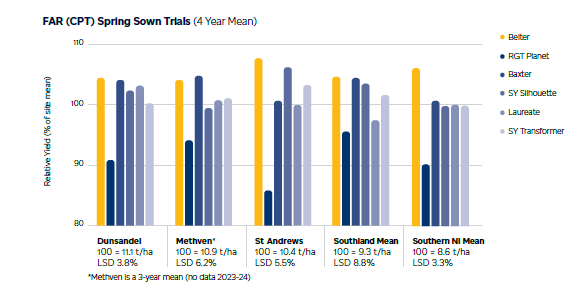
- One of the highest yielding new spring barleys in FAR CPT trials
- Bred as a non GN dual distilling/ malting barley but with high grain yields
- Good disease profile with good disease resistance to net blotch and powdery mildew
- Large grain, average test weights and very low screenings
Description
BELTER is an exciting new spring barley cultivar bred by SECOBRA RESEARCH UK spring barley programme and further developed by PGG Wrightson Grain (PGW Grain). A spring barley with very high yield potential that is suitable for feed, distilling and malting. It has an intermediate maturity and can be planted late or under dryland but has high yield potential with irrigation and appropriate inputs.
YIELD
Based on FAR CPT trials in 2025-26, BELTER has shown a high yield potential in most environments. It was in the top group for yield across the four Canterbury sites and central Southland and had the highest mean yield over the two North Island sites. It has topped the South Canterbury site for the past two seasons (CPT1 in 2024-25). It has not been tested in autumn trials to date but will be in both FAR and PGW Grain autumn trials in the 2026-27 season.
GRAIN QUALITY
|
Canterbury Spring |
Southland Spring |
Lower North Island Spring |
|---|---|---|---|
| Kernel weight (1000 seed weight) | 58 | 56 | 61 |
| Test Weight (kg/hl) | 62 | 62 | 62 |
| Protein content (%) (N% x 6.25) | 11.3 | 12.8 | 9.9 |
| Screenings (%) | 2.2 | 3.9 | 1.4 |
TIME OF DRILLING
BELTER has proven itself over a wide range of spring planting times in both FAR and PGW Grain trials. Although untested in the autumn, we anticipate a sowing window like other varieties from May right through to late October and beyond. Growing conditions and yield potential always dictate plant growth regulator (PGR) requirements, and even though BELTER has stiffer straw compared to Laureate, it will benefit from a moderate PGR programme especially in the autumn and in very high growth environments.
SPEED OF DEVELOPMENT
Month Planted |
Typical heading dates for BELTER in Canterbury |
| May | Late October |
| September | Late November |
BELTER has an intermediate development rate for harvest maturity.
SEED RATE AND TILLERING CHARACTERISTICS
BELTER is a medium to high tillering variety, and target plant populations should be within the standard PGW Grain barley seed sowing rate guidelines.
SOIL TYPE, ROTATION AND GEOGRAPHY
BELTER can be planted on all soil types where barley is already grown and can be grown as a first or second-year cereal. As a second-year cereal, barley is generally more take-all tolerant than wheat, however, yield will be lower than a first-year barley crop.
DISEASE RESISTANCE
BELTER is mostly resistant to powdery mildew and is moderately resistant to scald and net blotch. However, it is moderately susceptible to leaf rust. Considering this disease profile, BELTER will need a moderate to robust fungicide programme. In the 2025/26 PGW Grain spring fungicide trial, BELTER produced a moderate untreated yield and fungicide responses of 0.8-1.8 t/ha. The fungicide trial is being repeated for the 2026/27 season in the autumn and spring and should provide further information. Please contact your local PGW Representative for site specific recommendations.
Disease resistance results:
Disease |
PGW Grain Disease Nursery ratings
|
| Scald | 7 |
| Net blotch | 7 |
| Leaf rust | 5 |
| Powdery mildew | 8 |
STRAW STRENGTH AND HEIGHT
BELTER is a medium height cultivar with moderate to stiff straw. Autumn sowings will require a robust plant growth regulator investment, especially under irrigation. In spring, this cultivar will still require a moderate to high PGR programme to prevent brackling and maintain high yields. The actual programme is determined by a combination of local conditions, management and yield potential. As with any cultivar, do not apply PGR if the crop is under any form of stress. Please contact your local PGW Representative for site specific recommendations.
