
LG Caprice Winter Barley

- A very high yielding new winter barley
- Medium height, stiff-strawed
- Excellent disease resistance
- BYDV tolerance benefits
Description
LG CAPRICE is a true winter barley bred in the UK by Limagrain and further developed by PGG Wrightson Grain (PGW Grain). It requires vernalisation and time for tiller development, therefore is only suitable for autumn sowings. It performs best from earlier sowings in late March and April to take advantage of its high tillering habit and disease resistance.
YIELD
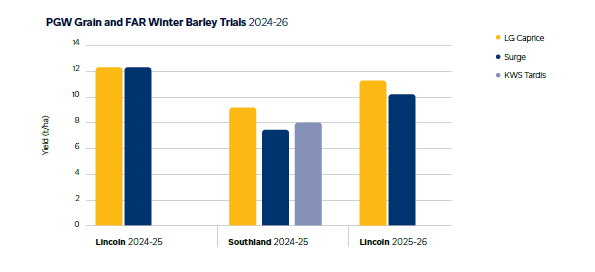
In PGW Grain and FAR trials over several seasons, LG CAPRICE has demonstrated significantly higher yields, ranging from 10-21%, compared to Surge and other commercially available winter barleys.
GRAIN QUALITY
|
Lincoln |
|---|---|
| Kernel weight (1000 seed weight) | 58 |
| Test Weight (kg/hl) | 60 |
| Screenings (%) | 2.6 |
LG CAPRICE produces a medium size grain of good test weight with low to moderate screenings.
TIME OF DRILLING
The optimum drilling time for LG CAPRICE is late March to late April. There may be some reduction in yield in early May, more so on dryland, lighter country and higher altitude areas. From early- May sowings, yields will tend to decrease but will be similar to spring barley planted at this time. However, its superior disease resistance makes it an alternative to spring barley for early May planting. By mid-May, the grower should switch to a spring barley like SY Transformer or Belter. On drier country where summer moisture stress is expected, this cut off can come in late April or the first week of May.
SPEED OF DEVELOPMENT
Month Planted |
Typical heading dates for LG CAPRICE in Canterbury |
| Late March | Late October |
| Mid-April | Early November |
| Early May | Mid-November |
LG CAPRICE is a cultivar with early to mid-maturity at harvest.
SEED RATE AND TILLERING CHARACTERISTICS
LG CAPRICE winter barley can produce a large number of tillers like most winter cultivars. Work being conducted by FAR in the 2026/27 season will further define tillering ability and help fine tune optimal sowing rates.
Month Planted |
Establishment rates for LG Caprice (plants/m2) |
| March – Early April | 125 – 150 |
| Mid April | 150 |
| Late April – Mid May | 175 |
SOIL TYPE, ROTATION AND GEOGRAPHY
LG CAPRICE can be planted on all soil types where barley is already grown and can be grown as a first or second-year cereal. As a second-year cereal, barley is generally more take-all tolerant than wheat, however, yield will be lower than a first-year barley crop.
DISEASE RESISTANCE
LG CAPRICE has an excellent disease resistance profile and is mostly resistant to scald, net blotch and powdery mildew. It is moderately resistant to leaf rust. Some diseases may be present in late winter on older leaves, but this will disappear with new spring growth. Considering this disease profile, fungicide programmes should be tailored for the control of Ramularia. Please contact your PGW Representative for site specific recommendations.
Disease resistance results:
Disease |
Limagrain Disease Ratings
|
| Scald | 6 |
| Net blotch | 5 |
| Leaf rust | 7 |
| Powdery mildew | 7 |
STRAW STRENGTH AND HEIGHT
LG CAPRICE is a medium height cultivar with good straw strength and stand-ability, however, it can brackle on ripening. Due to its high yield potential, it will require a moderate plant growth regulator programme, focussing on early season stem strength and late season height reduction to prevent lodging or brackling. The actual programme is determined by a combination of sowing date, seed rate, nitrogen use, crop thickness and yield potential. As with any cultivar, do not apply if the crop is under any form of stress. Please contact your local PGW Representative for site specific recommendations.
